It was easy enough not to think about during the first half of training. We were all busy adjusting to the new culture, getting to know each other, our teachers and our host families, and galvanizing our stomachs against the new food. But by the time the second half of training rolled around, it became the question on everyone’s mind: where on earth am I getting sent for the next two years?
To be fair, we did get some say in where we went. During the summer we had placement meetings where we got to express our site preferences. Like any selfless Peace Corps volunteer with a mild savior complex, my top priority was of course to be at the site where they felt I could do the most good. Then, all other things being equal, I wanted to go somewhere with other PCVs I could collaborate with (and hangout with, and commiserate with…), especially a business volunteer since I want to get more into the economic development side of things after I finish here. And just in case the powers that be were feeling especially generous, I’d also take some nice mountains and rivers if it wasn’t too much to ask. That’s good, they said, usually if you can come up with a few different things you want we can probably give you at least one of them—but of course it’s good not to get your hopes up too much.
Then as the diabolical and prolific Peace Corps rumor mill got spinning, there of course were hints. Rumor had it most of my language class was getting sent to the East. East, I thought, well not much in the way of mountains or rivers, but hey, who doesn’t enjoy a vast, featureless steppe? We had been told there also weren’t any health sites in UB, the capital, or in Bayan Olgii, the far western province that was almost entirely Kazak and required switching language training at the end of the summer. This again seemed to confirm my going east.
And there was also what we could deduce through reason. As one of the few health volunteers, I knew I had a pretty high chance of being placed in an aimag center, i.e. a provincial capital, and hence I would probably live in an apartment. At first I found this a little disappointing since a part of me was looking forward to the experience of life in a ger—not to mention the extra hardcore points you rack up living in a felt tent during a -40 F winter. Though in time I came to realize, as much as I wanted that experience, more so I wanted to be as effective a volunteer as I could, and that probably wasn’t going to be the case if I had to spend a huge fraction of my time and energy shoveling coal, building dung fires, and thawing my toothpaste every morning.
It wasn’t until our second site placement interview though that things really started to get interesting. Have you ever heard the expression, “Don’t do something well because you’ll probably get asked to do it again?” Because I’m pretty sure the Mongolia site placement staff certainly have. Our meeting started out with some unsolicited praise of my resume, which I appropriately took as a sign to brace myself.
We see here you’ve volunteered in quite a few developing countries… (nod) …And that your undergraduate studies were also very relevant for the type of public health work Peace Corps focuses on… (nod) …Which is why we’ve decided to almost certainly send you to a “fix-it” site. (quizzical single eyebrow raise)
Now there are basically three types of Peace Corps sites a volunteer can go to: a new site whose host agency has never had a previous volunteer, a site whose host agency had a good relationship with its previous volunteer, or a site whose previous volunteer is making the host agency consider never speaking to Peace Corps again. I’ll let you guess which one a “fix-it” site is.
Now don’t worry, they said, of course it’s hard to know how much the problem stemmed from the volunteer or the host agency, but we’re sure you’ll do fine. Oh, and by the way, no one at your health department speaks any English. Good luck on your language proficiency exam!
Marvelous, I thought. Good thing my evening study time has been replaced by practicing the Jalam Har till my lungs collapse every night.
Then as the summer wound down everyone, including myself, became increasing ambivalent of the prospects of shipping out to site. On the one hand, by the end of training, each day seemed more of an exercise in patience than language, culture or technical knowledge. Yet at the same time we had all come to recognize the cruel joke that all the people you had trained with, and grown closest to over the summer, composed the only small group of people you were guaranteed not to get placed with at site.
Like it or not though, site placement day finally rolled around, and when they unfolded the giant map of Mongolia that covered about half the gym floor, it quickly got a lot more tangible. And then when someone said if you’re within arm’s length of the person next to you, that’s about a five hour commute, it started making sense why we’re one of the few Peace Corps countries that gives out cell phones for emergencies and our sanity.
Well, East, I thought as I waited to hear my name called, the longest site that way is only about 12 hours by bus. Not terrible considering some of the western fly-sites are about three straight days on a bus when Peace Corps won’t pay for a flight. At least this way I can afford to meet up with people in UB every so often.
Then, to my surprise, I was one of the first people called. I looked at where the other people at my site who had already been called were standing—about two feet away from the western tip of the country. I started reading my info packet. It began: “***** is remote, even by Mongolian standards.” Fly-site, approximately three straight days drive from the capital, under good weather conditions, if the bus doesn’t breakdown. About as far west as you can go before everyone starts speaking Kazak. I looked across the map at my friends as they slowly got called. I couldn’t have even hit any of them with my six foot lacrosse stick, let alone touch them. So much for that.
Disappointing as it was at the time though, I’ve since come to realize I’ve actually probably got one of the best sites in Peace Corps. Firstly this aimag center is in many ways the capital of western Mongolia so to speak. It’s fairly large at about 30,000 people, gets a decent amount of amenities from trade with Russia and China, and has a beautiful, mountainous, desert landscape with a nearby pair of parallel rivers. It’s also a secondary head quarters for many NGOs outside of Ulaanbaatar, which means lots of people to work with and good potential sources of funding. It also means there are several other foreign researchers and volunteers (Swiss, Russian and Danish), which on top of the other 6 PCVs living here, means we are some of the few volunteers who have something resembling a normal social life. Plus we’re on the standard Central Asia travel route so we even get the occasional couch surfers as well—such as the French Canadian, self-proclaimed gypsy couple that played the accordion for tips to fund their adventure across Asia.
After the ominous foretelling of a fix-it site, work has also been surprisingly smooth—though I can’t say as much for my introduction with my director, Dr. Jamsran. Having missed the formal introduction ceremony and luncheon due to flight trouble, the only time I spent with him before coming to Khovd was a brief afternoon of mildly awkward Peace Corps group workshops, usually sans translator. Then before parting ways we agreed on when I would meet him to take our taxi to the airport. “Margash bid nar heden tsag yawen we?” (“Tomorrow we what time go?”), I asked in my broken Mongolian. “Dzorgan tsag,” (“Six o’clock”) he answered. Just to be sure, I rephrased my question and asked again, after all I certainly didn’t want to start my relationship with my boss for the next two years on the wrong foot. Same response: six o’clock.
After far too short a night’s rest, I woke up at 4:30 am to give myself plenty of time to shower, eat, and hit the ATM before we left. Not a minute after my alarm went off I heard a knock at my door. Must be one of my friends with an earlier flight wanting to say good-bye, I thought to myself, or maybe just someone with the wrong room. So I stumble to the door half-wake, disheveled from the previous night’s revelries and wearing only my boxers. As I open the door, the only thing that keeps my jaw from hitting the floor is the surge of adrenaline that hits me as I discover not only my director, but his daughter and toddler grandchild patiently waiting for me in the hall. Apparently six was when we're supposed to be at the airport.
My brain instantly starts reeling as it leaves my body paralyzed in the doorway. No call, no text. How did he even know where my room was in this enormous dormitory?! I stammer out an “uchlaarai” (“sorry”), as I swiftly close the door on him, his daughter and his grandchild, and begin furiously dressing and trying to get my hair to not look like I’m impersonating a homeless Conan O’Brien. Having broken several land speed records packing and hauling my immense amount of luggage downstairs, I then got to suffer the further embarrassment of having to ask to stop at an ATM on our way to the airport.
Despite that possibly being the most embarrassing moment of my life, you'll all be happy to know I’ve made a full recovery, and surprisingly I don’t think my relationship with my director actually suffered much because of it. At the time he really took it in stride, and since then I’ve learned that since Mongolians have traditionally been housing entire families in gers the size of large camping tents, privacy is something that is virtually non-existent in Mongolia. And then on top of that, since during our New Year’s Party several men in our health department sacrificed their pants during a women's cross-dressing competition, I’d say my own faux pas wasn’t in fact too big a deal.
As I’ve worked here, my relationship with my director and coworkers has been very amicable. From what I’ve gathered, the tensions with the last volunteer a few years ago came from the fact that she felt underutilized since the Health Department never gave her much to do, and the Health Department thought she was lazy since she never did very much. Fortunately however, though it may not be as easy or efficient as getting a specific assignment, I’m quite ok with finding my own work to do. So far, aside from my requested English and computer classes, that’s included iodine deficiency education, helping children with disabilities, sex education, alcohol seminars and installing enough free anti-virus software to make Norton rollover in his grave. Unlike the TEFL volunteers who make more of a measured impact everyday with their classes, I feel like my most lasting impacts will come from projects that I do that are more high risk, high reward. I’m sure most of my pursuits will be dead ends, but I think if I can get a few projects to stick, I’ll feel like I did my part.
Like my work, my apartment was also pleasantly surprising—even despite the occasional sheep slaughter on the sidewalk outside. It’s quite large, four rooms, about 700 sq feet—pretty much the size of my old host family’s actually. It was fairly well furnished, aside from the kitchen, which more or less consisted of a sink, rice cooker, hot plate, uneven card table, and a duct tape patched pot, which created some excitement the first time I tried to cook with it. Despite the separate living room and bed room, I moved everything into one room to conserve heat, an indispensable strategy in winter I’ve heard, especially when the electricity and/or hot water goes out, as it briefly does a few times a week. I figure the smaller bedroom can serve as a walk-in fridge. I also have a TV, with cable, which means I get all the fuzzy Mongolian television I can watch. Aesthetically the apartment is pretty nice too, though the wavy, light blue and white wallpaper makes you feel like you’re in a glacier, which I fear may be a little too prophetic. However, it still beats my friend’s place which literally has shining gold leafed walls, and a golden shag futon. It pretty much feels like you’re in 70’s version of King Tut’s tomb.
The town itself here also has quite a lot of character. Like most areas of Mongolia there are occasional, scattered animal remnants, and the packs of stray dogs perennially battle the cows for the scraps around the garbage pyres. The local outdoor market is enormous and constantly bustling year-round with people selling everything from sheep heads to camel-wool vests to Pantene Pro-V. The dual rivers on the edge of town are beautiful and make for a wide, lush plain where people go to play, picnic and do laundry when the weather allows it. Though what I’m sure I’ll always remember the most about Khovd is Red Mountain, a craggy, crumbling mountain on the edge of town that looks different every hour of everyday, and which cradles the sun and the moon as they rise each day and night.
Though perhaps less than glamorous, I could still certainly think of much worse places to live for two years.
Thursday, December 30, 2010


Tuesday, October 12, 2010
At Long Last, Pictures
So I've finally got around to uploading my first album of pictures from Mongolia. These start at the beginning of training and go up through swearing-in and my various adventures here at site. You can download any of the pictures using the "download" tab in the upper left above the pictures. Hope you enjoy them.
http://picasaweb.google.com/ned.lederer/Mongolia#
http://picasaweb.google.com/ned.lederer/Mongolia#
Thursday, September 16, 2010
End of the Beginning
First off, my apologies for taking so long to get the word out on what I’ve been up to. The second half of our training this summer was far busier than the first, and it’s only now that I’ve settle in at my new site that I’ve gotten the chance to catch up with myself. However, before I get too far ahead of myself let me begin where I left off.
The second half of our summer began with Nadaam, the festival of the Three Manly Sports, which is the second biggest Mongolian holiday after Tsagaan Sar, the New Year’s festival, in the winter. Most aimag (“eye-mag”) centers (10-30,000 people) and soums (1-10,000) have their own local Nadaams consisting of a few days of wrestling, horseracing and archery competitions. Though a little dull to watch since you can only see the beginning and end of the several kilometer long courses, the horse races are never the less quite the spectacles to observe since the horses often collapse from sheer exhaustion during or after the lengthy races, and the jockeys are almost universally children, some as young as 3, chosen for their light weight. Not surprisingly, the practice has recently been under a lot of criticism as a human rights violation since almost every year a few children are seriously injured or even killed during the races throughout the country.
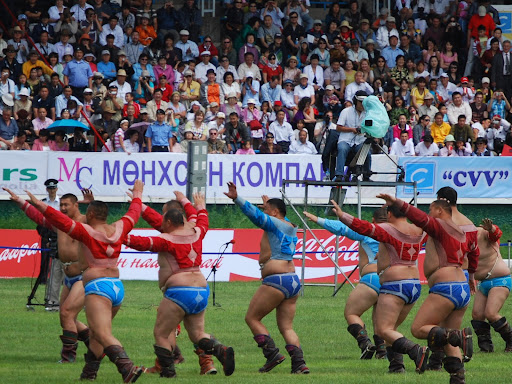
The wrestling is also quite a spectacle in its own right. The rules are unique in that the object is simply to get your opponent to hit the ground before you do; there are no boundaries or weight classes; and several matches are usually held simultaneously in a large arena. Probably most notably of all, however, are the wrestling outfits they wear. By Western standards, I would wager almost any amount of money that you couldn’t find a more herculean group of men out there, taking themselves so seriously, in such contrastingly emasculative clothing. But rather than try—and undoubtedly fail—to adequately describe the wrestling uniforms, I will simply refer you here.
The story behind these exceptional outfits is that years ago a woman entered and won the preeminent wrestling competition by wearing a man’s deel (the large traditional robes) to hide her gender. This, of course, was an intolerable affront to the male dominated sport, and Mongolian culture at large, so they in turn designed these outfits to universally bar women from participating in the sport, thereby reclaiming the dignity of the rightful male participants. On an unrelated note, no, irony is not a prominently featured topic in Mongolian literature. (My preemptive apologies for the ethnocentric jokes. I just couldn't help myself, and I'm well the US is guilty of far worse fashion movements.)
It was also during Nadaam that I first tried the infamous Mongolian Airag, i.e. the traditional drink of fermented mare’s milk. I was surprised in that it didn’t live up to my expectations of being as formidable as one might imagine, though I was equally surprised by how long the aftertaste lingers in one’s mouth. The best I can describe it is it’s like drinking a milk based wine that hits you with a strong, but tolerable, initial sour punch, followed by a lingering, unsettling milk-like flavor that nature hadn’t ever intended man to drink.
Our Mid-Center Days training was also a lot of fun since it was the first time we all got to see each other again since our first few days in country. Aside from another great middle school style dance party with our trainers and Mongolian teachers, I think my favorite part had to be getting to swap our stories of the quintessentially Mongolian, and otherwise just generally farcical, moments we had all gone through. For instance, one of my good friend’s host family was kind enough to get him a Mongolian horseback riding lesson …and then serve him the same horse for dinner the following evening. People from several different training sites had stories of getting shocked by their local ATMs, and on two separate occasions, it turned out a PCV’s host family had been squatting on their property. One of the times resulting in all of the volunteer’s stuff getting strewn out on the lawn when the family disassembled her ger to move without telling her. A friend of mine was served a sealed beer filled with water, and another volunteer spent the night in a five person car with her host family of seven and two goats because they got lost on the way back from their trip to the hudoo (i.e. the rural countryside).
My own best story was the night I wound up sleep walking into the room where my host brother, 22, and sister, 20, were sleeping. I apparently woke them by tugging on their blankets, mumbling something along the lines of, “It’s like fun…” (which has since become something of our tag line of our training this summer), before my host siblings somehow finally got me to go back to bed without waking me. The next day then played out like the amnesia-driven plot of a B-list movie as I tried to figure out why my family is acting so weird towards me, followed by me trying to profusely apologize and explain the concept of sleepwalking in my broken Mongolian.
However, there have also been some stories that crossed the line from the comically frustrating and uncomfortable into the seriously regrettable. Domestic violence is a huge, and largely unaddressed, problem in Mongolia. Most Mongolians consider it within the rights of each family to resolve internal conflicts, and therefore there is little outside intervention from neighbors, the authorities or anyone else. Out of the 15 volunteers in our town during training, at least three of them observed some form of domestic violence within, or involving, their host family, creating no small amount of tension within their living situations. During our final days in the capital before shipping out, I also witnessed an incredibly violent fight between two women on the steps of a bank, during which the guard standing ten feet away did nothing but stand there and watch. Even from across the street it was hard to stop myself from intervening, but as the Peace Corps warned us, to do so would expose us not only to physical danger, but a Kafkaesque legal system where we would receive little sympathy for having interfered where we didn’t belong. Understandably domestic violence has become an area of focus for many volunteers, and encouragingly the classes they have held seem to have so far been met receptively.
Fortunately though, those experiences have certainly been in the minority, and the second half of our training was overwhelmingly positive. Our first major event was having a Peace Corps sponsored traditional Mongolian horhug with our host families and language teachers. Now a horhug is like a big US barbeque in many respects: you go to a nice outdoor space, play games, and eat meat with your hands. The differences though are quite notable. First, instead of putting the meat in the grill, you put the grill in the meat, by which I mean you literally cook a goat/sheep/whatever by stuffing it full of searing hot rocks about the size of your hand. You then dismember the animal and put the meat in a giant, covered pot with some vegetables and the still hot rocks to cook some more. Then before eating, you remove the rocks and hand them to people to juggle until they are cool enough to hold—for absolutely no apparent reason. And, of course, you just can’t really compare nibbling on a chicken wing to ripping the meat off a goat’s scapula—though I have to admit the lack of A1 or BBQ sauce is a glaring detractor.
However, because our gratitude towards our host families could not be expressed in a single event (and because Peace Corps gave us more money), we had another Host Family Appreciation Day later in the summer. This time though the tables were turned, and the 15 of us volunteers spent the morning sharing an industrial sized kitchen with the staff of a Korean summer camp as we prepared pizza, onion rings, lemonade, brownies, apple cinnamon hoshurs (think small calzones), and pasta salad—which I made, and hence unsurprisingly later primarily served as dog food—all the while listening to the Korean kids and their full-sized, yellow, teddy bear mascot sing camp songs in the adjoining room. The party then consisted of us feasting in the school auditorium, performing via karaoke our limited Mongolian repertoire, as well a few American songs, and then having those of us who were learning dance pieces for our swearing-in ceremony perform those as well. And yes, there is going to be another post covering that whole dancing saga.
The second half of training also held our first community outreaches in conjunction with our family clinics. As much as the projects were designed to benefit the communities we were serving in, they were also designed to familiarize us with the challenges of working in a less results-oriented culture. And did they ever. Despite getting along very well with the counterparts in our clinic, it was quite the challenge to ever actually meet with them to work on our project or hold English classes for them. On the whole, about three times out of four, despite them choosing the time and location of our meetings, they wouldn’t make it for some reason. In fact, one of the most productive meetings we had was when our group of PCVs caught them during a break at a medical training seminar, and we just had an impromptu meeting on the spot.
The real kicker though was the day of our final anti-smoking presentation that we been building up towards for a few weeks. We went to the clinic and not only had we lost our venue, which was previously the poorly lit hallway of a kindergarten next door, but because it was about 50° F with a little wind and drizzle, they thought too few of the 30-40 doctors and nurses we were supposed to present to would come due to the bad weather. That’s right, a little drizzle and light wind at 50 degrees Fahrenheit is insurmountable weather—in Mongolia. However, after a few remarks from our training coordinators behind closed doors—or at least behind a pretty sizable language barrier—and the presentation was back on. We just didn’t quite know where and for whom quite yet…
This led us to another clinic across town where we quickly scrambled to find power outlets, chairs and participants for our hastily rescheduled presentation. Slowly Mongolians of all ages start trickling in as we realize our clinic doctors are simply calling everyone on their contact lists to try to boost attendance. We now faced a couple dozen Mongolians, age 5-75, without the hour of preparation we had expected, in a new, overly crowded venue, with a presentation designed for medical professionals. Wonderful.
Quickly our well planned concert of educational lectures, interactive games and group competitions, devolved into an exercise in improvisation and damage control as we tried to adapt our materials to the new circumstances sans translator. As we floundered to explain our objectives to our clinic’s head doctor who was doing most of the actual talking, we passed around candy to try to placate our audience, while also realizing we don’t have a way to make hot drinks, a transgression no doubt akin to a personal betrayal given Mongolian culture and the “awful” weather.
After an about an hour or so of awkwardly interrupting ourselves as we stumbled through our presentation, we start to feel the relief that only the end of such a prolonged debacle could bring. Then, entirely unexpectedly, one of the oldest gentlemen in the room stood up, and though we couldn’t understand his exact words, it’s clear he is giving us the most heartfelt expression of appreciation you could ever imagine an anti-smoking presentation receiving. Needless to say, we were stunned. And as the session ended and we started to get feedback from our trainers and our fellow PCVs, we were pleasantly surprised to find that despite the setbacks, they felt we handled it well, and the staff at our clinic were truly impressed with, and very grateful for, the effort we put into the presentation and educational materials we made for them. Then, when a few days later when we went to the clinic to say our final good-byes, the staff each gave us a Chingis Khan key chain, a miniature morinkhuur (the traditional horse-head fiddle), and a lovely card teaching us how to write our names in traditional Mongolian script, which currently resides on the wall of my new apartment.
Then as training wound down, we had our final days all together at site where we received even more warnings about STIs, the Mongolian drinking culture, and our inevitable gastrointestinal ailments—which in fact a few of my site mates and I are suffering from as I write. And, of course, we had a final dance party with our language teachers, PCV trainers and all. Finally the 75 of us packed up our bags, said our tearful good-byes to our host families, and loaded up the buses for our final stretch together in Ulaanbaatar before being flung to the far corners of the steppe.
Once in UB, as one might expect, our group of young twenty-somethings responsibly saved all of our substantial moving-in allowance, and celebrated our last few evenings together modestly, while enjoying the various historical and cultural monuments the world’s coldest capital has to offer…or something like that. I, for one, especially enjoyed my first joint Mexican/Indian food restaurant, and finally got to try the infamous American Burger and Fries, which after two and half months of mutton, did not disappoint. Our days in UB ultimately peaked with our spectacular swearing-in ceremony, which as I hinted at before, will be covered in detail in another update. Though I think it’s very interesting, and worth mentioning here, that Peace Corps Volunteers in fact take the US Oath for Federal employees, i.e. the one you usually associate with military service about protecting the Constitution from all enemies foreign and domestic, etc. If you’re interested, you can find it in its entirety here.
Anyways, our final days together went by far too quickly, and even our final hurrah at a grungy roller rink-disco hybrid with an enormous Scrooge McDuck spray painted on the wall, couldn’t entirely make up for the knowledge that we would soon part ways for several long months with the great friends we made that summer. Fortunately though, as I believe we are the sparsest active Peace Corps country, we are among a small subset of volunteers worldwide that get PC issued cell phones, and with increasingly available internet access, we will at least be able to keep in touch, if not in sight.
The second half of our summer began with Nadaam, the festival of the Three Manly Sports, which is the second biggest Mongolian holiday after Tsagaan Sar, the New Year’s festival, in the winter. Most aimag (“eye-mag”) centers (10-30,000 people) and soums (1-10,000) have their own local Nadaams consisting of a few days of wrestling, horseracing and archery competitions. Though a little dull to watch since you can only see the beginning and end of the several kilometer long courses, the horse races are never the less quite the spectacles to observe since the horses often collapse from sheer exhaustion during or after the lengthy races, and the jockeys are almost universally children, some as young as 3, chosen for their light weight. Not surprisingly, the practice has recently been under a lot of criticism as a human rights violation since almost every year a few children are seriously injured or even killed during the races throughout the country.
The wrestling is also quite a spectacle in its own right. The rules are unique in that the object is simply to get your opponent to hit the ground before you do; there are no boundaries or weight classes; and several matches are usually held simultaneously in a large arena. Probably most notably of all, however, are the wrestling outfits they wear. By Western standards, I would wager almost any amount of money that you couldn’t find a more herculean group of men out there, taking themselves so seriously, in such contrastingly emasculative clothing. But rather than try—and undoubtedly fail—to adequately describe the wrestling uniforms, I will simply refer you here.
The story behind these exceptional outfits is that years ago a woman entered and won the preeminent wrestling competition by wearing a man’s deel (the large traditional robes) to hide her gender. This, of course, was an intolerable affront to the male dominated sport, and Mongolian culture at large, so they in turn designed these outfits to universally bar women from participating in the sport, thereby reclaiming the dignity of the rightful male participants. On an unrelated note, no, irony is not a prominently featured topic in Mongolian literature. (My preemptive apologies for the ethnocentric jokes. I just couldn't help myself, and I'm well the US is guilty of far worse fashion movements.)
It was also during Nadaam that I first tried the infamous Mongolian Airag, i.e. the traditional drink of fermented mare’s milk. I was surprised in that it didn’t live up to my expectations of being as formidable as one might imagine, though I was equally surprised by how long the aftertaste lingers in one’s mouth. The best I can describe it is it’s like drinking a milk based wine that hits you with a strong, but tolerable, initial sour punch, followed by a lingering, unsettling milk-like flavor that nature hadn’t ever intended man to drink.
Our Mid-Center Days training was also a lot of fun since it was the first time we all got to see each other again since our first few days in country. Aside from another great middle school style dance party with our trainers and Mongolian teachers, I think my favorite part had to be getting to swap our stories of the quintessentially Mongolian, and otherwise just generally farcical, moments we had all gone through. For instance, one of my good friend’s host family was kind enough to get him a Mongolian horseback riding lesson …and then serve him the same horse for dinner the following evening. People from several different training sites had stories of getting shocked by their local ATMs, and on two separate occasions, it turned out a PCV’s host family had been squatting on their property. One of the times resulting in all of the volunteer’s stuff getting strewn out on the lawn when the family disassembled her ger to move without telling her. A friend of mine was served a sealed beer filled with water, and another volunteer spent the night in a five person car with her host family of seven and two goats because they got lost on the way back from their trip to the hudoo (i.e. the rural countryside).
My own best story was the night I wound up sleep walking into the room where my host brother, 22, and sister, 20, were sleeping. I apparently woke them by tugging on their blankets, mumbling something along the lines of, “It’s like fun…” (which has since become something of our tag line of our training this summer), before my host siblings somehow finally got me to go back to bed without waking me. The next day then played out like the amnesia-driven plot of a B-list movie as I tried to figure out why my family is acting so weird towards me, followed by me trying to profusely apologize and explain the concept of sleepwalking in my broken Mongolian.
However, there have also been some stories that crossed the line from the comically frustrating and uncomfortable into the seriously regrettable. Domestic violence is a huge, and largely unaddressed, problem in Mongolia. Most Mongolians consider it within the rights of each family to resolve internal conflicts, and therefore there is little outside intervention from neighbors, the authorities or anyone else. Out of the 15 volunteers in our town during training, at least three of them observed some form of domestic violence within, or involving, their host family, creating no small amount of tension within their living situations. During our final days in the capital before shipping out, I also witnessed an incredibly violent fight between two women on the steps of a bank, during which the guard standing ten feet away did nothing but stand there and watch. Even from across the street it was hard to stop myself from intervening, but as the Peace Corps warned us, to do so would expose us not only to physical danger, but a Kafkaesque legal system where we would receive little sympathy for having interfered where we didn’t belong. Understandably domestic violence has become an area of focus for many volunteers, and encouragingly the classes they have held seem to have so far been met receptively.
Fortunately though, those experiences have certainly been in the minority, and the second half of our training was overwhelmingly positive. Our first major event was having a Peace Corps sponsored traditional Mongolian horhug with our host families and language teachers. Now a horhug is like a big US barbeque in many respects: you go to a nice outdoor space, play games, and eat meat with your hands. The differences though are quite notable. First, instead of putting the meat in the grill, you put the grill in the meat, by which I mean you literally cook a goat/sheep/whatever by stuffing it full of searing hot rocks about the size of your hand. You then dismember the animal and put the meat in a giant, covered pot with some vegetables and the still hot rocks to cook some more. Then before eating, you remove the rocks and hand them to people to juggle until they are cool enough to hold—for absolutely no apparent reason. And, of course, you just can’t really compare nibbling on a chicken wing to ripping the meat off a goat’s scapula—though I have to admit the lack of A1 or BBQ sauce is a glaring detractor.
However, because our gratitude towards our host families could not be expressed in a single event (and because Peace Corps gave us more money), we had another Host Family Appreciation Day later in the summer. This time though the tables were turned, and the 15 of us volunteers spent the morning sharing an industrial sized kitchen with the staff of a Korean summer camp as we prepared pizza, onion rings, lemonade, brownies, apple cinnamon hoshurs (think small calzones), and pasta salad—which I made, and hence unsurprisingly later primarily served as dog food—all the while listening to the Korean kids and their full-sized, yellow, teddy bear mascot sing camp songs in the adjoining room. The party then consisted of us feasting in the school auditorium, performing via karaoke our limited Mongolian repertoire, as well a few American songs, and then having those of us who were learning dance pieces for our swearing-in ceremony perform those as well. And yes, there is going to be another post covering that whole dancing saga.
The second half of training also held our first community outreaches in conjunction with our family clinics. As much as the projects were designed to benefit the communities we were serving in, they were also designed to familiarize us with the challenges of working in a less results-oriented culture. And did they ever. Despite getting along very well with the counterparts in our clinic, it was quite the challenge to ever actually meet with them to work on our project or hold English classes for them. On the whole, about three times out of four, despite them choosing the time and location of our meetings, they wouldn’t make it for some reason. In fact, one of the most productive meetings we had was when our group of PCVs caught them during a break at a medical training seminar, and we just had an impromptu meeting on the spot.
The real kicker though was the day of our final anti-smoking presentation that we been building up towards for a few weeks. We went to the clinic and not only had we lost our venue, which was previously the poorly lit hallway of a kindergarten next door, but because it was about 50° F with a little wind and drizzle, they thought too few of the 30-40 doctors and nurses we were supposed to present to would come due to the bad weather. That’s right, a little drizzle and light wind at 50 degrees Fahrenheit is insurmountable weather—in Mongolia. However, after a few remarks from our training coordinators behind closed doors—or at least behind a pretty sizable language barrier—and the presentation was back on. We just didn’t quite know where and for whom quite yet…
This led us to another clinic across town where we quickly scrambled to find power outlets, chairs and participants for our hastily rescheduled presentation. Slowly Mongolians of all ages start trickling in as we realize our clinic doctors are simply calling everyone on their contact lists to try to boost attendance. We now faced a couple dozen Mongolians, age 5-75, without the hour of preparation we had expected, in a new, overly crowded venue, with a presentation designed for medical professionals. Wonderful.
Quickly our well planned concert of educational lectures, interactive games and group competitions, devolved into an exercise in improvisation and damage control as we tried to adapt our materials to the new circumstances sans translator. As we floundered to explain our objectives to our clinic’s head doctor who was doing most of the actual talking, we passed around candy to try to placate our audience, while also realizing we don’t have a way to make hot drinks, a transgression no doubt akin to a personal betrayal given Mongolian culture and the “awful” weather.
After an about an hour or so of awkwardly interrupting ourselves as we stumbled through our presentation, we start to feel the relief that only the end of such a prolonged debacle could bring. Then, entirely unexpectedly, one of the oldest gentlemen in the room stood up, and though we couldn’t understand his exact words, it’s clear he is giving us the most heartfelt expression of appreciation you could ever imagine an anti-smoking presentation receiving. Needless to say, we were stunned. And as the session ended and we started to get feedback from our trainers and our fellow PCVs, we were pleasantly surprised to find that despite the setbacks, they felt we handled it well, and the staff at our clinic were truly impressed with, and very grateful for, the effort we put into the presentation and educational materials we made for them. Then, when a few days later when we went to the clinic to say our final good-byes, the staff each gave us a Chingis Khan key chain, a miniature morinkhuur (the traditional horse-head fiddle), and a lovely card teaching us how to write our names in traditional Mongolian script, which currently resides on the wall of my new apartment.
Then as training wound down, we had our final days all together at site where we received even more warnings about STIs, the Mongolian drinking culture, and our inevitable gastrointestinal ailments—which in fact a few of my site mates and I are suffering from as I write. And, of course, we had a final dance party with our language teachers, PCV trainers and all. Finally the 75 of us packed up our bags, said our tearful good-byes to our host families, and loaded up the buses for our final stretch together in Ulaanbaatar before being flung to the far corners of the steppe.
Once in UB, as one might expect, our group of young twenty-somethings responsibly saved all of our substantial moving-in allowance, and celebrated our last few evenings together modestly, while enjoying the various historical and cultural monuments the world’s coldest capital has to offer…or something like that. I, for one, especially enjoyed my first joint Mexican/Indian food restaurant, and finally got to try the infamous American Burger and Fries, which after two and half months of mutton, did not disappoint. Our days in UB ultimately peaked with our spectacular swearing-in ceremony, which as I hinted at before, will be covered in detail in another update. Though I think it’s very interesting, and worth mentioning here, that Peace Corps Volunteers in fact take the US Oath for Federal employees, i.e. the one you usually associate with military service about protecting the Constitution from all enemies foreign and domestic, etc. If you’re interested, you can find it in its entirety here.
Anyways, our final days together went by far too quickly, and even our final hurrah at a grungy roller rink-disco hybrid with an enormous Scrooge McDuck spray painted on the wall, couldn’t entirely make up for the knowledge that we would soon part ways for several long months with the great friends we made that summer. Fortunately though, as I believe we are the sparsest active Peace Corps country, we are among a small subset of volunteers worldwide that get PC issued cell phones, and with increasingly available internet access, we will at least be able to keep in touch, if not in sight.
Subscribe to:
Posts (Atom)